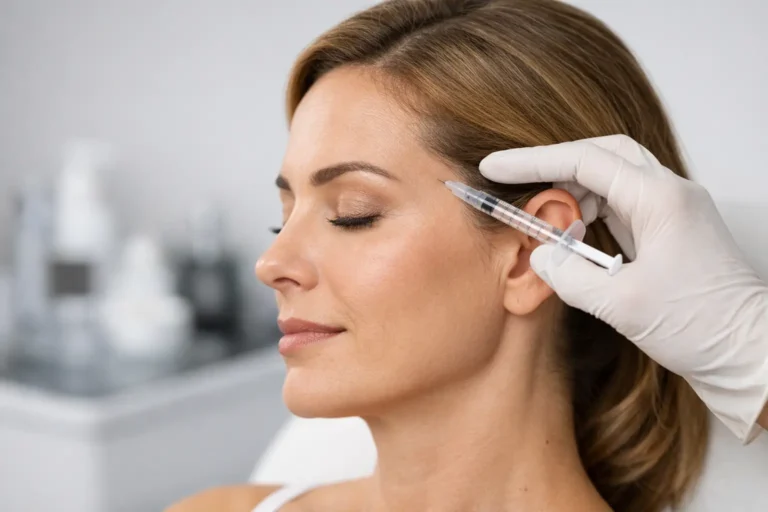
The Riskiest Places for Filler (and Why Your Injector Matters)
The riskiest place for fillers, in our view, is the area between the eyebrows (the glabella), with the nose and the area beside the nose close behind. These spots have small blood vessels that connect back toward the eye, so filler injected in the wrong plane can block blood flow. That’s rare, but it’s the reason injector skill and anatomy knowledge matter more than the price per syringe.
We’re not writing this to scare anyone. Filler is a very safe treatment in trained hands. But you deserve to know where the real risks sit, and what a careful injector does about them.
Why some areas are riskier than others
Almost every serious filler complication traces back to one thing: vascular occlusion. That’s when filler ends up inside a blood vessel, or presses on one hard enough, to cut off blood supply to the skin beyond it.
If it isn’t caught quickly, the skin in that area can be damaged. In very rare cases, when the blocked vessel connects to the arteries that feed the eye, it can affect vision. That’s the complication every good injector thinks about every single time they pick up a syringe.
So “risky” doesn’t mean “bad results are common here.” It means the vessels are small, close to the surface, or connected to important structures, and the margin for error is thin.
The riskiest place for fillers, plus the other high-risk zones
Here’s how our nurse practitioners think about the higher-risk zones of the face. This isn’t every consideration, but it covers the areas we get asked about most.

| Area | Why it’s higher risk | What a careful injector does |
|---|---|---|
| Between the brows (glabella) | Small vessels here connect to the arteries around the eye | Usually treats 11 lines with Botox instead of filler |
| Nose | Thin skin, limited blood supply, vessels linked to the eye | Very conservative, specialized technique, or a referral |
| Beside the nose and smile lines | The facial and angular arteries run through this zone | Correct depth, small amounts, often fixes cheek support first |
| Temples | Several vessels and layers in a small space | Precise depth, slow injection, sometimes Sculptra instead |
| Forehead | Vessels near the surface connect toward the eye | Rarely uses filler here at all |
| Under the eyes | Thin skin, swelling, risk of lumps or a bluish tint | Careful candidate selection and the right product |
A word on the glabella and the nose
Most published cases of filler-related vision problems involve these two areas. That’s why we generally say no to filler between the brows. Botox for frown lines handles that area beautifully without putting product near those vessels.
Non-surgical nose jobs get a lot of attention on social media. If you’re considering one anywhere, ask your injector how many they do, what product they use, and what their plan is if blood flow is compromised. If the answers are vague, walk away.
Under the eyes
The tear trough is less about danger and more about doing it right. The skin is thin, the area swells easily, and the wrong product or depth can leave puffiness or a bluish cast. Not everyone with dark circles is a good candidate. Our guide to the best under-eye treatments explains when filler makes sense and when something else is a better fit.
Why your injector matters more than the product
The syringe doesn’t know where it is. The person holding it does.
Safe filler comes down to a few habits we treat as non-negotiable:
- Deep anatomy knowledge. Knowing where vessels usually run, and that they don’t always run where the textbook says.
- Slow, small, low-pressure injections. Less product at a time gives the injector a chance to notice a problem early.
- The right tool for the area. Sometimes a blunt cannula, sometimes a needle at a specific depth.
- Watching the skin the whole time. Sudden blanching, unusual pain, or a dusky, mottled color means stop.
- Hyaluronidase in the room. We keep it on hand for every filler appointment, not in a cabinet across town.
Florida law also matters here. Not everyone who offers filler is allowed to inject it, and credentials vary a lot from one spa to the next. We walk through what to check in who can inject Botox in Florida, and the same questions apply to filler.
Why we stick with dissolvable HA fillers in high-risk zones
Hyaluronic acid fillers like the Juvéderm and Restylane families can be broken down with hyaluronidase. If we ever suspect a vessel is compromised, we can start dissolving right away. That safety net is a big reason we prefer HA products in delicate areas. We cover how that process works in can filler be dissolved.
Biostimulators like Sculptra work differently and can’t be dissolved. They have their place, especially for gradual volume, but placement and patient selection matter even more.
Warning signs after filler you should never ignore
Normal filler aftermath looks like mild swelling, tenderness, and maybe a bruise. That’s expected, and most people head back to work or out to Restaurant Row that night without anyone noticing.
Call your injector right away if you notice any of these:
- Pain that’s severe or getting worse instead of better
- Skin that looks white, gray, blue, or blotchy in a lacy pattern
- Skin that feels cool to the touch compared with the other side
- Small whiteheads or blisters appearing in the treated area a day or two later
Any change in vision, eye pain, or drooping after filler is an emergency. Call 911 or go to the nearest ER, then call your injector. Our post on whether injectable fillers are safe goes deeper on everyday side effects versus true complications.
Quick answers
What is the most dangerous area to inject filler?
Most experts consider the glabella, the area between the brows, the riskiest place for fillers, followed by the nose. Vessels there connect to the blood supply of the eye, so complications, while rare, can be more serious.
Can filler cause blindness?
It can, but it’s very rare. It happens when filler blocks a vessel connected to the eye’s blood supply, which is why careful technique and avoiding filler in the highest-risk areas matter so much.
Is lip filler risky?
Lips are a common, generally safe area, but they do have arteries running through them. Correct depth, small amounts, and an injector who knows the anatomy keep the risk low.
How can I lower my risk of a filler complication?
Choose a licensed, experienced injector who uses HA filler in delicate areas and keeps hyaluronidase on hand. Ask how they’d handle a complication before you book, not after.
If you’re thinking about filler and want a straight answer on what’s safe for your face, we’re happy to talk it through. Learn more about our dermal fillers in Orlando, then book a free consultation or call 407-440-2025. We’ll tell you plainly if we think a different treatment, or no treatment, is the better call.
This article is for general education and isn’t a substitute for an in-person medical evaluation. Every face is different, so the best plan comes from a consultation.

Read More LightTouch Med Spa Articles