Botox vs. Filler: What’s the Difference and Which Do You Need?
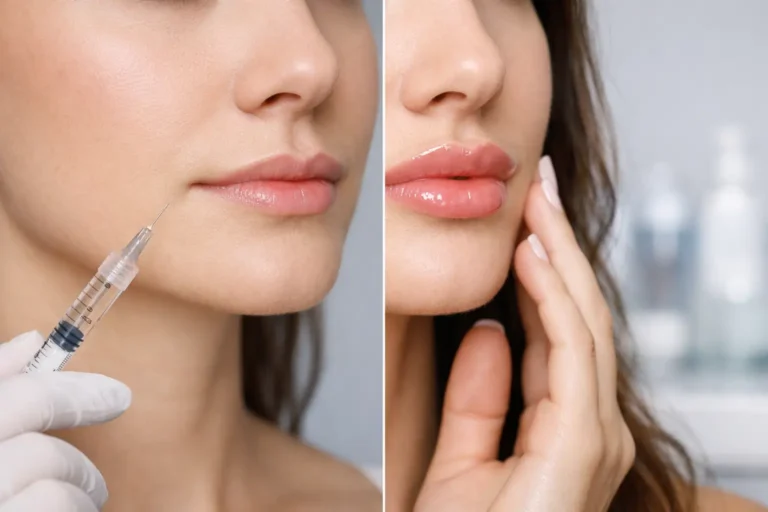
The simplest way to think about Botox vs filler: Botox relaxes muscles to soften lines caused by movement, while filler adds volume to restore shape or fill lines that are there even when your face is still. Botox is for frowning, squinting, and raising your brows. Filler is for thin lips, flattened cheeks, and deeper folds.
We hear “I think I need Botox, or maybe filler?” in consults every week. That’s a fair question, because the two get lumped together constantly. Here’s how they differ, where each one shines, and how we decide which you actually need.
Botox vs filler: how each one works
They’re both injectables, but they do completely different jobs.
Botox and other neurotoxins
Botox, Dysport, and Xeomin block the signal that tells a muscle to contract. When the muscle can’t pull as hard, the skin above it stops folding as deeply, and lines soften. Nothing is added to your face. It just moves a little less in the areas we treat.
Dermal fillers
Most fillers we use are hyaluronic acid gels from the Juvéderm and Restylane families. They’re placed under the skin to replace lost volume, add structure, or smooth a fold. You see the change right away, though swelling settles over a week or two. Sculptra is a different category that gradually builds your own collagen.
The short version is that Botox changes movement and filler changes volume.
What Botox treats best
Botox is the go-to for dynamic wrinkles, the lines that show up when you make an expression.

- Frown lines between the brows (the 11s)
- Horizontal forehead lines
- Crow’s feet around the eyes
- Bunny lines on the nose
- A gummy smile, a lip flip, or a downturned mouth
- Jaw clenching and masseter slimming
- Excessive underarm sweating, which is a big one in an Orlando August
Frown lines are the classic example. Our recent post on Botox for 11 lines explains how dosing and results work in that area. For more about what we treat, see our Botox in Orlando page.
What Botox can’t do is replace volume. If your cheeks have flattened or your lips have thinned, relaxing a muscle won’t bring that back. Our article will Botox get rid of wrinkles covers where it helps and where it falls short.
What filler treats best
Filler is for static lines and volume loss, changes that are visible even when your face is relaxed.
- Lips that are thin, uneven, or losing definition
- Cheeks that have flattened with age
- Smile lines (nasolabial folds) and marionette lines
- Hollow temples or under-eye hollows, in the right candidate
- Chin and jawline definition
- Facial balancing to improve proportions
Different products suit different areas. Voluma and Volux are firmer for cheeks and jaw, while Volbella and Kysse are softer for lips. Our guide to what Juvéderm is used for explains the lineup, and our dermal fillers page covers the full range we offer.
One more practical difference: hyaluronic acid filler can be reversed. If something isn’t right, it can be dissolved with hyaluronidase, which we keep on hand. Our post on whether filler can be dissolved explains how that works. Botox can’t be dissolved, but it wears off on its own.
Side-by-side comparison
| Botox | Filler | |
|---|---|---|
| What it does | Relaxes muscles | Adds volume and structure |
| Best for | Lines that appear with movement | Lines at rest, lost volume, shape |
| When you see results | 3 to 5 days, full at about 2 weeks | Right away, settled in 1 to 2 weeks |
| How long it lasts | About 3 to 4 months | Roughly 6 to 18 months or more, by product and area |
| Downtime | Minimal | Swelling and possible bruising for several days |
| Reversible? | Wears off on its own | HA filler can be dissolved |
Why many people end up needing both
Most faces age in more than one way at once. Lines from movement and loss of volume tend to show up together, especially after 35 or 40, and especially after years of Florida sun.
A common example: someone comes in for the deep lines around their mouth. Some of that is volume loss, which filler helps. Some is the muscle pulling the corners down, which Botox helps. Treating only one side of the problem gives a half-finished result.
When we do combine them, the order and spacing matter. Botox can quiet a muscle that would otherwise work against filler, so filler around the mouth or chin often looks smoother and may hold its shape a bit better when the muscle above it is relaxed. In some cases we treat both in one visit. In others, we start with Botox, let it settle for two weeks, then decide how much filler you really need. Usually it’s less than people expect.
That said, we won’t push you into both. If one treatment answers your concern, that’s what we’ll suggest. Starting with one and adding later is a perfectly good plan, and we often prefer it for first-timers so you can see how you respond. If you want to see how we think about the whole face, our facial balancing guide is a good read.
Quick answers
Is Botox or filler better for wrinkles?
It depends on the wrinkle. Lines that appear when you make expressions respond best to Botox. Lines that are visible at rest, or folds caused by volume loss, usually need filler.
Which lasts longer, Botox or filler?
Filler generally lasts longer. Botox lasts about three to four months, while most hyaluronic acid fillers last six months to a year or more, depending on the product and area.
Can you get Botox and filler at the same time?
Often, yes. Many patients have both in one visit, and we plan placement so each product does its job. We’ll walk through timing at your consultation.
Is filler safer than Botox?
Both are very safe in trained hands, but they carry different risks. The main serious filler risk is blocking a blood vessel, which is rare and treatable when caught quickly. That’s why your injector’s experience matters for both.
If you can’t tell which you need, Botox, filler, or neither, that’s exactly what a consult is for. Our nurse practitioners will look at your face, tell you what we’d do, and tell you what we wouldn’t. Book a free consultation or call 407-440-2025 to visit us on Sand Lake Rd.
This article is for general education and isn’t a substitute for an in-person medical evaluation. Every face is different, so the best plan comes from a consultation.

Read More LightTouch Med Spa Articles